Views: 0 Author: Site Editor Publish Time: 2026-06-25 Origin: Site

Mechanical study timers are making a remarkable comeback. Users frequently praise their satisfying tactile feedback. You twist the dial, hear the winding spring, and feel ready to tackle deep work. However, this analog nostalgia hides serious productivity costs. The classic wind-up timer definitely offers a healthy disconnect from digital screens. Yet, these mechanical tools introduce structural inaccuracies. They rely on disruptive auditory triggers. Their rigid, single-function design completely fails to support complex modern study methodologies.
For students and professionals managing high cognitive loads, time management must evolve. A Digital Study Timer transitions your workflow from a blunt countdown into a precision focus framework. This comprehensive guide evaluates the structural, psychological, and analytical advantages of upgrading your focus toolkit. We will explore exactly why modern cognitive work demands smarter, adaptable time-tracking solutions over their traditional counterparts.
Traditional mechanical timers charm us. They look elegant on a desk. They require no batteries. However, beneath their vintage aesthetic lies a fundamentally limited technology. We must evaluate them critically against modern demands.
Mechanical timers run on a simple physical principle. They use wound springs and interlocking gears. As the spring unwinds, an escapement mechanism releases energy in tiny steps. This system possesses inherent structural flaws. Environmental factors like humidity or temperature alter gear friction. Over time, internal components wear down.
This mechanical drift becomes exceptionally problematic during short intervals. A standard Pomodoro session demands a five-minute micro-break. When you twist an analog dial to the five-minute mark, physical tension varies. It might ring at three minutes. It might ring at seven. This inaccuracy destroys the precise pacing required for high-level cognitive recovery.
The auditory nature of a mechanical timer acts as a double-edged sword. Some individuals find the rhythmic ticking grounding. For many others, this constant sound induces severe "Timer Anxiety."
A loud, ticking countdown mimics a high-stress game show environment. Your brain perceives the noise as a looming threat. Cortisol levels rise. Instead of focusing on your textbook, your attention shifts to the passage of time. True deep work requires you to forget time altogether. Intrusive auditory cues actively prevent you from entering a flow state.
Analog tools perform one rigid function. They count down to zero and stop. They cannot automatically sequence work-to-break transitions. When your twenty-five-minute focus block ends, the alarm blares. You must physically grab the device, silence it, and manually twist it back for your break. This forced manual intervention yanks you completely out of your flow state.
Common Mistake: Relying on a single mechanical timer for complex workflows often leads to skipped breaks. Users simply forget to wind it again, leading directly to mental burnout.
| Feature | Mechanical Timer | Digital Timer |
|---|---|---|
| Accuracy | Prone to mechanical drift, poor under 5 minutes. | Exact-to-the-second precision via microcontrollers. |
| Auditory Impact | Constant ticking induces timer anxiety. | Completely silent operation available. |
| Workflow | Requires manual reset after every single session. | Auto-sequences focus and break intervals seamlessly. |
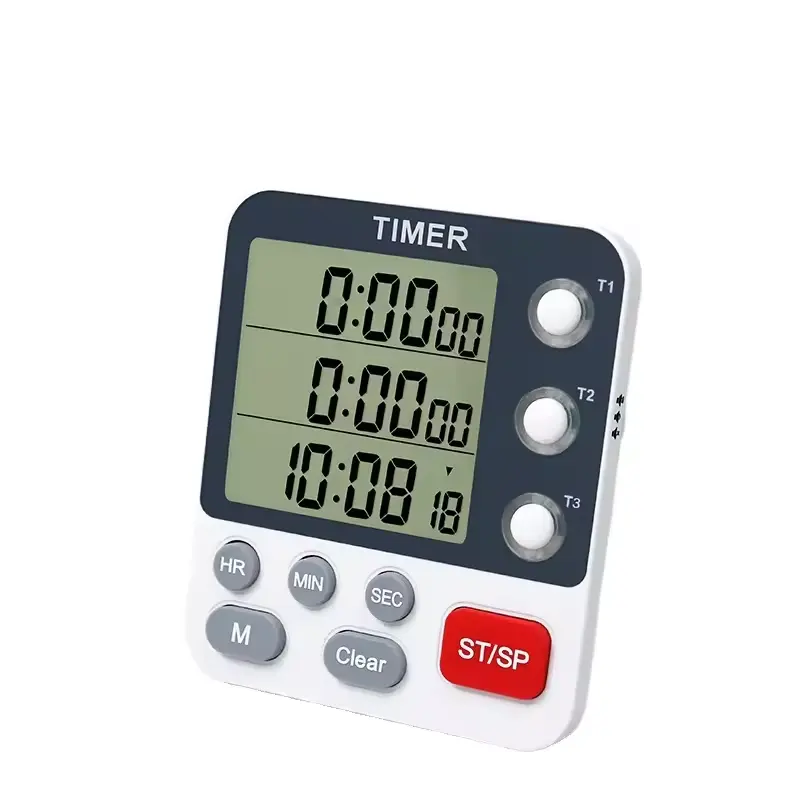
A modern Digital Study Timer fundamentally solves the mechanical shortcomings of analog devices. It replaces gears with electronic circuits. This shift from physical to digital offers unmatched technical superiority.
Digital timers rely on internal microcontrollers and quartz oscillators. They deliver exact-to-the-second accuracy. This precision matters immensely during rapid task-switching. Imagine alternating between intensive memorization drills and quick administrative tasks. You need your micro-breaks to last exactly three minutes. An exact digital countdown prevents cognitive overload by maintaining a strictly controlled pace.
Different tasks require entirely different psychological approaches to time.
Traditional timers strictly serve the Timer Mindset. They only count backward. Digital tools adapt dynamically to both. They offer stopwatch functions alongside countdowns, scaling seamlessly to your specific cognitive task.
Public study spaces demand discretion. A ringing mechanical bell violates library etiquette. A Digital Study Timer excels here through "mutable alarms." Advanced units utilize subtle visual alerts. A small LED flashes quietly. A digital cube pulses gently. You receive the necessary interruption without disturbing others or startling yourself.
Time management tools must account for user psychology. They must support diverse neurological needs. Digital tools provide crucial accommodations for neurodivergent individuals navigating complex cognitive tasks.
Neurodivergent individuals, particularly those with ADHD, frequently experience "time blindness." Time feels abstract. It exists only as "now" or "not now." Standard analog clocks fail to provide meaningful feedback. Users struggle with task closure because they cannot physically feel five minutes passing.
Advanced digital visual timers translate abstract numbers into tangible progress. They use disappearing color blocks. They feature clean progress bars. You place the device on your desk. You gauge time organically in your peripheral vision. You never break your deep concentration to read a dial. The visual representation anchors your focus effortlessly.
The "break spiral" destroys productivity. You finish a focus session. You take a five-minute manual break. That break rapidly morphs into forty-five minutes of unstructured social media scrolling. Digital timers prevent this.
Best Practice: Use auto-start intervals. Program your digital timer to launch a five-minute break immediately after your focus block. Once five minutes pass, the next focus block begins automatically. This automation removes decision friction and strictly limits unstructured downtime.
High-level productivity requires strategic frameworks. A blunt countdown no longer suffices. You need a device that integrates macro-level planning with micro-level execution.
Traditional time blocking solves the "what to do" problem. You block out three hours on your calendar for research. This combats decision fatigue. However, staring at a massive three-hour block causes intimidation. The Pomodoro technique solves "how to do it." It breaks work into digestible sprints.
Digital timers allow you to nest these methodologies. You schedule your macro block. Then, you program your digital timer for four automated Pomodoro cycles within that window.
| Methodology | Primary Function | Psychological Benefit |
|---|---|---|
| Time Blocking | Macro-planning (Schedule) | Eliminates decision fatigue. |
| Pomodoro | Micro-execution (Sprints) | Overcomes task initiation anxiety. |
| Hybrid Digital Setup | Automated nested intervals | Maintains flow and enforces recovery. |
A mechanical timer resets to zero. It literally erases your effort. Digital timers, especially app-based ones, log your completed sessions. This mechanism "inverts time."
We often suffer from the planning fallacy. We worry about lost time. Analytics turn that anxiety into a satisfying metric. You review your daily history. You see five completed deep-work sessions. You feel accomplished. This quantifiable data builds momentum and keeps you accountable.
We must transparently address a core risk. Digital tools frequently reside on devices engineered to distract us. We call this the distraction paradox.
Critics argue against digital app timers. They note we already suffer from "tab fatigue." Opening another browser tab for a timer invites distraction. Using your smartphone risks self-interruption. A WhatsApp notification derails your entire study session.
We solve this by differentiating the digital category. You must choose the right format for your vulnerability to distraction.
You understand the benefits. Now, you must select the appropriate tool. Use this logical framework to evaluate your options.
Evaluate your primary workspace. If you study in a library, prioritize a silent physical digital timer with visual alerts. If you work from a home office and love data, choose a robust desktop app. Match the device type to your specific environment and your personal susceptibility to digital distractions.
Traditional mechanical timers certainly offer a pleasant tactile novelty. However, they consistently fail to meet the rigorous demands of modern cognitive work. Their physical inaccuracies, disruptive noises, and rigid interfaces actively hinder deep focus. Upgrading your workspace transforms how you manage mental energy.
A digital study timer functions as an active workflow tool. It minimizes decision fatigue through automated intervals. It provides silent, precise alerts. It adapts flawlessly to both your psychological quirks and strategic planning needs. Take action today. Audit your current time-management tools, implement a digital solution, and reclaim your deep work capacity.
A: Yes, smartphone apps pose a high risk of self-interruption. Notifications easily derail focus. We highly recommend utilizing dedicated standalone digital hardware. If you must use a phone app, strictly enforce system-wide "Do Not Disturb" settings and app-blocking integrations during your sessions.
A: Absolutely. Visual digital timers specifically excel here. They replace abstract ticking numbers with clear graphical representations of elapsing time. Disappearing color blocks allow users to feel time passing intuitively, which deeply assists those struggling with time blindness.
A: You must match the interval length to your specific cognitive load. Use short 25-30 minute sessions for administrative tasks or rapid memorization. Extend the timer to 60-120 minutes for deep problem-solving or coding to effectively reduce context-switching costs.