Views: 0 Author: Site Editor Publish Time: 2026-07-28 Origin: Site

A chess timer can turn one quiet position into a race against seconds. Yet its basic operation is surprisingly simple.
It gives each player a separate time bank. After every move, one press stops your countdown and starts your opponent’s.
In this guide, you will learn how chess timers switch, track time, handle increments, and support fair tournament play.
A chess timer contains two clocks inside one shared unit. Each player receives one display and an individual time allowance. The device measures total thinking time, rather than assigning a fixed limit to every move.
Suppose both players begin with ten minutes. White may spend one minute on a difficult move, then only five seconds later. Those choices come from White’s ten-minute bank. Black’s time remains untouched during White’s thinking period.
The two clocks are interlocked, so they cannot normally count down together. When White’s side runs, Black’s side stays paused. After White moves and presses the nearby button, White’s timer stops and Black’s starts.
This switching action repeats throughout the game:
1. The active player studies the position while their own time decreases.
2. They make a legal move before touching the timer.
3. They press their side, stopping their clock and starting the opponent’s.
4. The opponent now thinks under their own remaining time.
Pressing the button completes the timed part of a move. If you forget, your own clock continues running, even after the opponent moves. Learning this rhythm prevents a painful, avoidable loss.
Separate time banks make slow thinking a personal cost. One player cannot consume the other player’s allowance by delaying. Organizers can also predict round lengths more reliably.
A Professional Tournament Chess Timers with Dual Display - GreatHome applies this dual-display principle across beginner, mechanical, and multifunctional digital models. Its product range includes basic controls, bonus settings, large buttons, and tournament-focused functions. These features change the user experience, but the alternating logic stays identical.
When a display reaches zero, it shows a “flag fall.” The term comes from analog clocks, where a small flag physically dropped. Digital units usually show an icon, frozen display, or other visible signal.
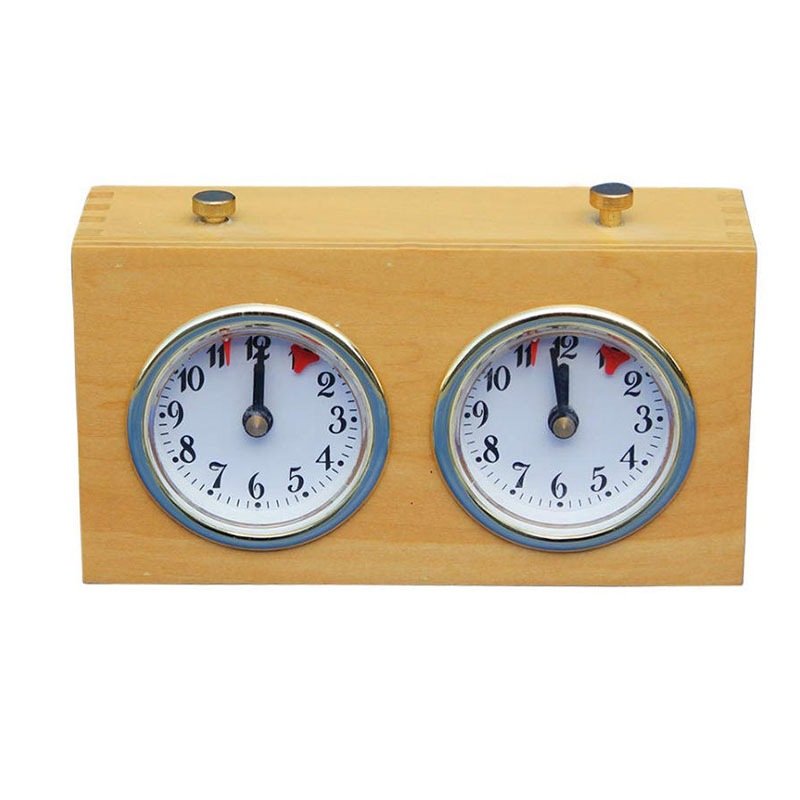
A mechanical chess clock uses two analog clock movements plus an interlocking lever. Pressing one button releases its movement and blocks the other. Spring-driven models need winding, while quartz versions use batteries.
Mechanical models usually count toward a marked finishing point. Players set both hands so the agreed period ends when the minute hand reaches that point. Near the limit, the hand lifts a small flag, which drops after time expires.
This system feels direct and familiar. However, reading seconds precisely can be difficult. Mechanical models also cannot calculate modern bonus time automatically.
A digital chess timer uses electronic timing circuits, buttons, and two displays. Its controller stores each player’s remaining time. Every valid button press changes the active side and applies the selected timing rule.
Digital timers can show minutes and seconds clearly. Many also store presets, count moves, support unequal starting times, and silence alarms. Their programmable logic makes increment, delay, and multi-stage controls possible.
Feature | Mechanical Chess Clock | Digital Chess Timer |
Time display | Analog hands | Numeric LCD or LED |
End signal | Physical flag fall | Icon, frozen digits, or light |
Timing precision | Approximate visual reading | Precise digital countdown |
Increment or delay | Usually unavailable | Commonly supported |
Setup | Manual hand adjustment | Presets or custom settings |
Best fit | Casual play and classic style | Training, clubs, and tournaments |
Both types enforce the same alternating turn structure. The difference appears when the time control becomes more complex. A simple five-minute game works on either device, but a 5+3 game needs digital programming.
Digital models also reduce disputes because players can see exact seconds. Some identify which side expired first. A move counter can trigger a later time period automatically during long events.
Mechanical clocks remain enjoyable for casual matches. For tournament preparation, an electronic chess clock better reflects current playing conditions. Always learn the exact model before a serious game, because button menus and symbols vary.
First, choose one time control for both players. A simple setting gives each side equal base time. More advanced settings add increment, delay, or another period after a required move count.
On a digital chess clock, select a preset or enter custom values. Check both displays before starting. Confirm the base time, bonus seconds, active player, sound setting, and move counter.
GreatHome offers simple models for students and clubs, plus programmable units for advanced events. Some models provide many presets, saved parameters, unequal player times, and mute operation. Those options help organizers prepare several boards consistently.
White makes the first move, so White’s time must run first. In casual play, Black usually starts White’s clock. At an official event, follow the arbiter’s setup and instructions.
Use this sequence:
1. Place the timer where both players can read it comfortably.
2. Confirm that both sides show the intended starting time.
3. Start White’s side, then let White make the opening move.
4. After moving, White presses the nearby button using the same hand.
5. Black’s clock begins, and the sequence continues after every move.
Your move must happen before the press. The time used to reach the button still belongs to you. Do not hold a finger over the control while your opponent thinks.
Most digital clocks include a pause control. Casual players may use it for an agreed break or setup correction. Tournament players should not pause simply to leave the board.
Under official rules, a player may pause to request an arbiter’s help. Examples include a missing promotion piece, a clock defect, or an illegal-move dispute. The arbiter decides the correction and restarts play.
Practice the physical rhythm before your first event. Make a move, release the piece, then press the clock smoothly. After several games, this sequence becomes automatic and leaves more attention for the board.
Base time is the main bank given to each player. A 10+0 setting means ten minutes per side and no added seconds. The entire game must finish before one player’s bank expires.
The notation X+Y usually means X base minutes plus Y increment seconds per move. Some platforms display the same idea as X|Y. You can review common examples in this guide to Time Controls in chess - Chess Terms - Chess.com.
Increment adds a fixed number of seconds after each completed move. In a 5+3 game, each player starts with five minutes. Pressing the clock after a move adds three seconds to that player’s remaining bank.
Delay protects the main bank differently. The timer waits for a fixed period before subtracting main time. If a five-second delay is active and you move within five seconds, the main bank stays unchanged.
Timing Mode | What the Timer Does | Can Time Accumulate? | Example |
No bonus | Deducts time immediately | No | 10+0 |
Fischer increment | Adds seconds after each move | Yes | 5+3 |
Simple delay | Waits before deducting base time | No | G/10 d5 |
Multi-stage | Adds a new period after a move target | Sometimes | 40 moves, then added time |
Increment rewards fast moves because unused bonus seconds remain available. Delay only protects the base time during its short window. Both reduce frantic endings caused by the physical effort of moving pieces.
Short formats demand simple controls and readable seconds. Bullet games can last only a few minutes per player. Blitz gives slightly more room, while rapid supports deeper calculation. Classical games may use long periods and staged controls.
The category depends on event rules, not merely a product label. A tournament chess timer must reproduce the announced setting exactly. Always check the event notice before copying a familiar preset.
Complex controls may add time after a certain move number. The clock’s move counter must stay accurate, so every press matters. An accidental double press can misreport the stage and require an arbiter’s correction.
The official Article 6: The Chessclock – FIDE Rules Commission require players to move and press using the same hand. A player may not hover over the button, press before moving, strike the unit, or knock it over.
These rules protect equal access to time. They also prevent damage during fast games. Press firmly enough to switch the timer, but never slam the control.
Reaching zero normally loses the game. However, FIDE rules call the result a draw when the opponent cannot possibly deliver checkmate through any legal sequence. In an event, let the arbiter handle disputed settings or flag claims.
Forgetting to press: Your clock keeps falling until you notice and switch it. Build a move-then-press habit during every practice game.
Choosing the wrong mode: A delay preset can look similar to increment. Verify how bonus seconds appear before starting.
Starting the wrong side: White’s time should run first. Check the active-side symbol before the opening move.
Using weak batteries: A dim display or failed switch can interrupt play. Replace batteries before important events and carry spares.
Changing settings midgame: Pause and call the arbiter when a correction is necessary. Never edit tournament settings independently.
Look for a high-contrast dual display, reliable buttons, simple menus, and stable feet. Clubs also benefit from saved presets and durable housings. Travelers may value low weight and controls protected inside a bag.
Founded in Fuzhou in 2008, Chess Timers & Competitive Equipment Manufacturer - GreatHome manufactures timers and other time-management products for international customers. Its chess line includes large-button beginner units and programmable tournament models. That range helps schools, clubs, distributors, and event organizers match functions to real use.
Before buying, test three tasks: setting a custom control, correcting a time value, and restarting a game. A capable timer should make all three clear. Advanced features have little value when players cannot operate them confidently.
A chess timer works by alternating two separate time banks after every move. Digital models add precise controls, while mechanical clocks preserve classic simplicity.
Choose the correct mode, verify both displays, and practice the move-then-press rhythm. A reliable timer keeps games fair, focused, and comfortably on schedule.
A: No. Pressing one side stops it and starts the other side.
A: Black usually starts White’s clock because White moves first.
A: Their own time continues falling until the clock is pressed.
A: Each player gets five minutes, plus three seconds after every move.
A: Usually. It is a draw if the opponent cannot possibly checkmate.