



| Quantity: | |
|---|---|
Parameter | Specification |
|---|---|
Timing Range | 1-60 minutes |
Operation | Mechanical wind-up, no batteries required |
Housing Material | Stainless steel and plastic |
Magnet Strength | Holds up to 5 lbs on ferrous surfaces |
Weight | 3 ounces |
Alert Volume | 55 decibels |
Display | Dual-colored disc (red and white) |
Disc Coating | UV-coated surface |
Finish | Scratch-resistant |
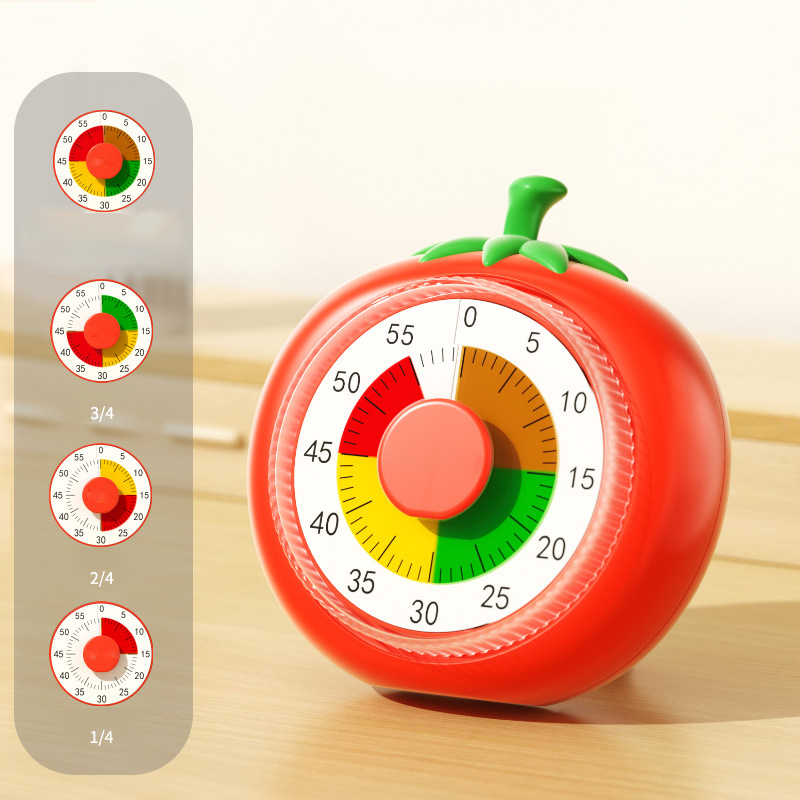
The tomato-shaped mechanical kitchen timer uses a wind-up mechanical movement to count down intervals from 1 to 60 minutes. Designed for commercial procurement buyers in food service, hospitality, and education sectors, the timer combines retro visual design with functional timing performance for everyday kitchen and workshop use.
The timer operates via a mechanical spring mechanism activated by rotating the dial. No batteries are required, eliminating ongoing battery replacement costs and reducing maintenance for facilities deploying multiple units across kitchens or classrooms. The pre-lubricated gear mechanism supports extended use with routine operation.
A dual-colored disc with red and white segments visually tracks elapsed time as the dial rotates. The UV-coated disc surface helps maintain color visibility under regular indoor lighting conditions. The analog display provides at-a-glance progress reading without requiring close inspection of numerical markings.
The timer body combines stainless steel components with plastic housing elements. Stainless steel parts contribute to corrosion resistance in kitchen environments with ambient moisture, while the plastic components reduce overall weight. The scratch-resistant finish supports daily handling in busy commercial settings.
The built-in magnet attaches securely to ferrous metal surfaces, holding up to 5 lbs of weight on compatible materials. This allows vertical mounting on kitchen appliances, metal toolboxes, and office whiteboards, saving counter and desk space. The 3-ounce weight ensures the magnet can support the timer in vertical orientation under normal conditions.
Restaurants, catering services, and commercial kitchens use the timer to coordinate dish preparation, track cooking intervals, and manage multiple simultaneous timing tasks. The magnetic design allows staff to attach timers directly to oven hoods, refrigerators, and prep stations for easy visibility during busy service periods. The 55-decibel alert provides audible notification without overwhelming kitchen ambient noise.
Bakeries, coffee shops, and cafés use the timer for baking intervals, brew cycles, and food holding time tracking. The tomato-shaped design complements kitchen décor in establishments with rustic or traditional themes, serving both functional and aesthetic purposes for front-of-house visible placement.
Educational labs, maker spaces, and woodworking workshops use the timer for experiment timing, glue curing intervals, paint drying periods, and process step tracking. The battery-free mechanical design works reliably in environments where digital devices may be affected by dust, moisture, or power availability constraints.
The timer produces a "ding" sound at approximately 55 decibels, which is audible in standard kitchen and office environments without being disruptive to nearby conversations or shared workspaces.
Yes, the timer can be wall-mounted using adhesive hooks or small nails compatible with its 3-ounce weight. The integrated magnet also allows attachment to any ferrous metal wall surface or mounting plate.
The timer weighs 3 ounces, which is light enough for magnetic vertical mounting while maintaining sufficient mass for stable tabletop placement during use.
No, the timer operates entirely through a mechanical wind-up spring mechanism. No batteries are needed for operation, reducing long-term consumable costs for commercial buyers managing multiple units.


